Leaves
Achaaqluk
|
Iñupiaq Name: |
Achaaqluk |
|
phonetic spelling: |
a-chok-look |
|
plural: |
achaaqluit |
|
translation /other information |
none known |
|
English Name: |
Beach greens |
|
Scientific Name |
Honckenya peploides |
|
Source: |
(L.) Ehrh. p.28 |
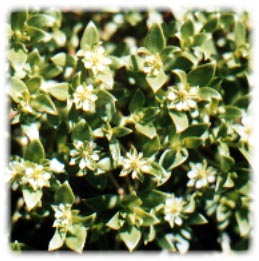
Achaaqluk is a beach plant that grows
abundantly on the sand on the spit in Golovnin. It grows in
matted bunches, intertwining with itself. The small white
flowers are inconspicuous, but once the flowers appear, the
plant is too old to be collected. Achaaqluk
was an important plant used for greens stored for winter,
but is less important now. Not as many people store
achaaqluk away for the winter, but my
grandmother remembers when everyone did. Most people will
collect the plant for immediate use and do not try to store
large quantities away for the winter. The last time my
grandmother made a barrel of achaaqluk
greens was sometime in the 1960's.
This decline in the use of plants in part due to the
presence of a general store in Golovin, run by Maggie Olson.
In1993, when Maggie closed the store for the winter, people
of the village were worried about how they would get food.
Many people traveled to Nome, the largest city on the Seward
Peninsula, 75 miles East of Golovin, to shop. Others ordered
their food from Nome or bush ordering companies. The only
place to buy food in Golovin was at the Primary School Store
run totally by the 1st and 2nd grade children in Golovin.
Their teacher, Cheryl Pratt, said that the kids did
everything: the ordering of food, the selling of food, and
counting back of change to the customers--everything. I was
happy to hear that the children of Golovin were learning to
cope in tough times. My hope with this plant collection is
that if Golovin ever finds itself without a store again that
everyone in Golovin will be able to find plants that can
help them survive the rough times. Seeing the children learn
to take care of the village, I know that my hopes will
become a reality.
To prepare achaaqluk for storage the stems
must be cut into 2 or 3 inch sections or the stringy inside
of the stem will remain in tact. Anges Amorak joked that it
is hard to digest that string and it comes out the same way
is goes in, if you don't cut it. Once the stems are cut,
they are boiled in water until they are soft. Once cooked
they are stored in barrels. Black berries are often mixed
into the barrels and eaten with sugar for a dessert.
My grandma warned that plastic containers for storage are
dangerous and barrels should be used or the most modern
method of storage is in ziplock bags in the freezer (or
"deep freeze" as she calls it). The plastic allows botulism
to grow, whereas the barrels are cured with hot wax to
prevent leakage and the growth of the deadly bacteria.