Leaves
|
|||||||||||||||||
 |
 |
||||||||||||||||
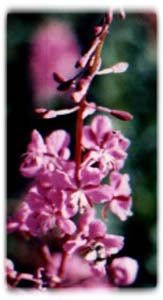
Pamutuq is a tall, sometimes reaching 5 or 6
feet, averaging about 3 feet, profusely growing plant that
grows all over Golovin. The homepage shows the vast areas
that are covered by fireweed. The petals are beautiful
purple-lilac colored and are present most of the summer.
The flowers bloom from the bottom of the flower stalk toward the top as summer goes on. When the bottom flowers begin to seed and the top flowers are almost done blooming, summer is almost over.
The name of this plant is my namesake. Maggie Olson's grandmother, the woman who raised her, whom Maggie called "Mama", and whom I am named after, was pamutuq. She always called fireweed pamutuq and it is nice to think her and these beautiful flowers that I am named after. The spelling here is with a "P" that is a "B" sound. I have always spelled my name with a "B" as in Bautnuq. I asked my grandma about this and she said that very few Eskimo words are spelled with a "B"; but, that it is right for me to use the "b" in my name.
Early in the summer, the young Pamutuq plant are eaten mixed with other greens. The fresh summer salads are eaten with seal oil as the dressing. Many of the greens may be mixed together to add different flavors and textures to the salads.
Later in the summer, when the flowers are in full bloom,
the petals may be collected to make fireweed jelly. The
flowers are boiled with water, sugar, and pectin until thick
and sealed in jars to preserve a bit of summer color for the
long winter months.
Eric Hulten writes in, "Flora of Alaska" that "the marrow is
eaten by the Natives and the leaves are used as a substitute
for tea in Russia. The root is also eaten by the Siberian
Eskimo." (Hulten, p. 688)