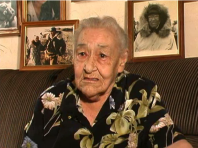
Background EssaySadie Neakok is an Iñupiaq Elder from Barrow, Alaska. Elders throughout all of Alaska have witnessed dramatic changes in the climate. They have deep-rooted knowledge in their cultural heritage and have adapted to many changes. One of the environmental changes the Iñupiat continues to see is the melting of the permafrost. This affects how the Iñupiat stores their food.
Sadie Neakok shares, “We used to store all our meat in this underground dugouts, what we call, ‘Ice Cellars’. And we would bring in all the catch we wanted saved: fish, seal, whale meat – if whaling was prosperous. And we would store it in the cellar. And it would keep indefinite. It wouldn’t spoil. Now we can’t do that. Our underground deep freezers are flooded with the permafrost going down and seepage into the… Each home now owns three or four freezers – electric freezers, too. Store our meat anymore.”
The Iñupiat have used ice cellars for thousands of years.
Siġḷuaq - Piqpakkutiqaġniq Aġviġmun, Tutquqsivik Nigipianun translates to “Ice Cellar - A Place of Respect, Storage for Meat”. People in some far-north places have dug, and still dig into permafrost to make “ice cellars” to store whale blubber and meat, and other game meat. Iñupiat whalers replace the snow floors in their ice cellars each spring in a cleaning effort that is also spiritual in a way: “A whale will not give itself to you unless there is a clean place for it to rest,” whalers in Barrow have said.
According to an Iñupiaq whaling family, one ice cellar is usually shared with a family. Every spring, the Iñupiat clean it out to prepare for spring whaling season. They remove everything that they stored and either share it with others or eat it. The dirty snow and ice is picked off with an axe by young crew members and hauled up by bucket from the ice cellar. Clean, fresh snow is brought down to the ice cellar and spread over the floor. Iñupiaq whalers say, “A whale will not give itself to you unless there is a clean place for it to rest.”
To learn more about the Native perspective on climate change, check
The Melting Ice Cellar.
To learn about other consequences of melting Arctic permafrost, including insects and fires, check out
Changing Arctic Landscape.
To learn more about the challenges of building over permafrost, check out
How to Build A Road.
To learn more about the different types of soils and how they are distributed over the planet, check out
Soils Around the World.
To learn more about permafrost, check out University of Alaska Fairbanks
Permafrost Outreach.